01 July 2025
A good idea can travel
The power of curiosity
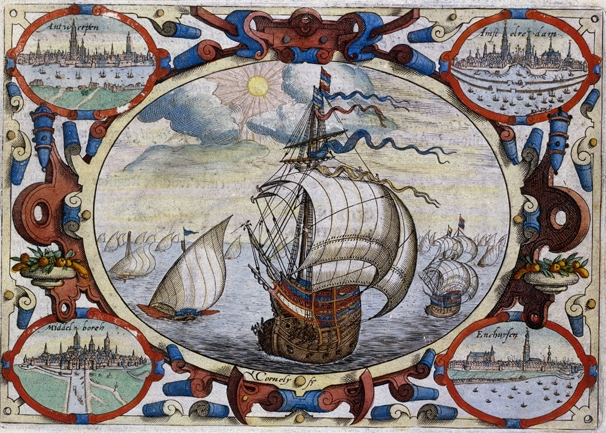
The agency where I worked some agencies ago (PPGH/JWT -WPP) wrote it as a sub-theme for ‘International Business’ of ABN AMRO under the campaign banner ‘It starts with ambition’. In our search, the brand diagnostics, for the ‘DNA’ of ABN AMRO we stumbled upon Jan Huygen van Linschoten at the time – a young cartographer and pioneer who, even before the birth of the Dutch East India Company, boarded sailing ships and charted the sailing routes to the far east. He published Reys-Gheschrift (1594) and Itinerario (1596) It marked the beginning of international trade, collaborations and capital flows. The mapped trade routes led to the success of the VOC, first stock exchanges, commercial banks, and eventually to the establishment of banks, such as in 1824 the Nederlandsche Handel Maatschappij, which after several mergers became ABN AMRO.
What we discovered during our search was not only a historical fact: the foundation of the brand strategy, but also that it was curiosity that drove Huygen. That one first step on board. Daring to enter unknown territory. And exactly that became the core of the campaign “It starts with ambition,” with by extension, “a good idea can travel.
Emotional connection through curiosity
Our British former colleague Richard Block, international head of strategy at JWT, and also involved at ABN AMRO once wrote:
“To introduce brands means you need to be in touch with what is desired. To be desired is to be wanted on an emotional level.”
The “emotional level” and “shared inside” of ABN AMRO’s sub-theme “a good idea can travel” rang true on all sides, and international entrepreneurs recognized themselves in it. That emotional connection – core, touch, desire, wanted – starts with curiosity. Curiosity is the mechanism behind desire, connection and meaning. Without that drive of wanting to know, you don’t start anything.
Meanwhile, years later, ABN AMRO’s “It begins” is still relevant: now in the form “For Every Beginning. It turns out to be sustainable. Because who you are, or what you become, depends not only on circumstances, but on what drives you. And what you do with that drive.
It’s all about control
In a recent post on LinkedIn, Maton Sonnemans writes about his mission to bring “imagination back to the boardroom. Here he shares figures from his research for Nyenrode Business University: Supervisory boards spend on average 80 to 95% of their time on finance, governance, and control. Only 5 to 20% goes to innovation.
It is a striking picture of our time. Control has become the dominant value system: control over time, behavior, and budgets. We invest billions in it. Because control can be sold. Control offers security. KPIs. Dashboards. Control. Look: we have everything under control.
But while control is the upper layer, value often resides precisely in the undercurrent. Studies show time and again that companies that structurally invest more in Research and Development, innovation and creativity are often also rated higher in the marketplace.
The experience economy megatrend is estimated to reach $3.8 trillion by 2028. Apple, Netflix, Spotify, LVMH, Liberty Media Corporation, all flourish because they steer not by control, but by experience and emotion. On curiosity. The Future is Human. Also in tech. Also in controlling.
Non-knowing as a condition for growth
To better understand the phenomenon of ‘curiosity’, I talked to Prof. Jan Bransen. Professor at Radboud University, where he teaches at the Behavioural Science Institute, as well as dealing with the philosophy of behavioral sciences. He puts curiosity in a deeper, philosophical context. Because what ís curiosity anyway, and why is it so valuable?
Philosophically, curiosity belongs to the so-called intellectual virtues. They are the qualities of the good thinker: wonder, openness, perseverance. Also, in virtue ethics, ignorance is not a fault, but a value. Curiosity is why you dare to leave your familiar territory. The first step toward the unknown.
Curiosity, says Bransen, is the counterpart of apathy and boredom. Both are symptoms of a system lacking meaning. What is needed is not absolute knowledge, but mild enthusiasm, wonder, and daring to question obviousness. Not knowing is not a deficit. It is a condition for growth. Vulnerability is part of it. The ability to postpone judgment. To allow yourself to be surprised.
Curiosity is necessary capital
The conservative thinking, the controlling, to which Sonnemans refers in his article, is perhaps conservatism as a reflex to fear of the unknown. Creativity demands the opposite: openness to chaos, to the new, to uncertainty. And thus: curiosity as a moral attitude. In which the strange, the unknown, has enormous appeal. Not knowing can be an enormous threat, but also an enormous opportunity. Curiosity is deeply ingrained in us. It is necessary for survival. Every species applies it to sustain itself. Curiosity is a necessity. Dare to be creative. It is our only chance. But education is generally not designed that way.
Bransen later refers to the Strange Situation Test, developed in the context of attachment theory: The idea there is that children naturally have an exploratory disposition (say, a drive you might call “curiosity”), and the test measures the extent to which small children dare to act on this natural tendency in a situation where their primary attachment figure is absent. You could take this to the level of today’s CEOs: Mother Earth, the safe environment, is absent, and to what extent, then do CEOs dare to explore? To what extent are they gripped by fear because they are insecurely attached. Today’s Master’s programs offer little guidance in this regard. It does not teach young people to independently dare anything on their own. It only teaches them to jump through all the hoops, and the multitude of tests systematically undermines their judgment (after all, they constantly need a good point of a “safe beacon”).
The result: leadership without attachment. Strategy without imagination. Governance without curiosity. It is what has happened to us because of the form of education we have chosen. It could be a huge loss in the long run.
Curiosity is necessary capital, not just in brand building or education, but in any sector where meaning, connection, or growth is relevant. It’s what made Apple’s Think Different great. It’s what drove pioneers like Huygen. It’s what inspires students, what leaders need, what fuels innovation. It’s what all ideas start with. Differentiation matters. The will to want to know matters. There are plenty of people interested in what you don’t yet know. In that sense, it’s simple: go get it.
A good idea can travel.
It all starts with curiosity.
Author: Peter Clercx, Creative Director TD