04 September 2025
Digital healthcare increases inequality — unless we design radically inclusively
Introduction
Digitalization is crucial for the future of healthcare. But as long as innovations are designed top-down, we end up excluding the people who need care the most. Real progress requires systemic change: moving out of the hospital and into the community. An approach that works for everyone starts with letting go of our own assumptions.
Communication plays a key role. Digital healthcare succeeds or fails not just because of technology, but above all because of the way we talk about it, explain it, and practice it together. Clear, accessible communication can bridge the gap and make digital tools reach the people who would otherwise drop out. If we don’t do this, communication itself can widen the divide. In the projects I Understand Your Care and Make Sure It Works (Citrienfonds), we explored at TD Zuiderlicht how it can be done differently: designing inclusively, with the target group, not for them.
Double pressure on healthcare
Healthcare is under pressure. Due to aging, rising prosperity, and increasingly complex, combined conditions, the demand for care is growing, while the number of available professionals is declining. Without digitalization, healthcare simply isn’t sustainable and, in the long run, won’t be accessible to everyone.
But digitalization is not a magic solution. On the contrary, if we don’t design inclusively, technology amplifies existing health disparities. The people who rely most on care are the ones at risk of being left behind. If we want digital healthcare to succeed, we need to approach it in a completely different way: inclusively, human-centered, and in collaboration with the target group.
Digital healthcare doesn’t work for everyone
In the Netherlands, 17% of the population has limited digital skills or no digital access. Behind that figure are older adults, people with a migration background, those living in poverty, and people with cognitive impairments, exactly the groups who more often experience health problems, have less access to care, and possess smaller social networks.
Yet digital innovations are often developed in boardrooms, by people who routinely use apps and never have to choose between Wi-Fi and groceries. As Tim ’s Jongers’ Poverty Explained to People with Money clearly shows, those who live with security, education, and structure tend to overestimate how accessible systems are for everyone. This is how well-intentioned solutions miss the mark in practice, widening the gap between policy and reality.
Take video calls with a general practitioner. For digitally skilled patients, it’s a convenient solution. But for those without a stable internet connection, a private space for the conversation, or knowledge of how a healthcare app works, it causes stress, confusion, and often delays in care. The same goes for digital patient records. In theory, they give patients control. In practice, thousands of people get lost in complicated portals, medical jargon, and login procedures like DigiD. For those who struggle with reading and writing, have poor vision, or lack digital skills, “taking control of your health” remains an empty promise.
The conclusion is clear: digital healthcare that isn’t designed from the start with the target group increases inequality. Inclusive innovation requires clear language, visual support, and the willingness to let go of our own assumptions.
Targeted approach: design thinking with the target group
The Citrienfonds program from ZonMw is working with healthcare professionals to build a future-proof healthcare system. Digitally Involved in Care, to which we at TD Zuiderlicht contribute through communication and co-creation, deliberately takes a target-group-focused approach. Innovations are not made for the target group, but with them; thinking along, making decisions, and challenging systems from day one.
In this, communication is not an afterthought but an integral part of the design. It’s not just: what are we developing? But also: how do we ensure that people understand, trust, and actually use digital healthcare solutions?
In sessions with citizens, patients, and experts by experience, surprising insights emerge. For example, the idea of sharing information about digital tools not only online, but also physically in community centers, supermarkets, or through family members. It is precisely these kinds of communication choices that determine whether digital healthcare helps people or excludes them.
Sometimes this means starting over, for example because illustrations meant to clarify actually cause more confusion, or because a participant says, “I tune out with PowerPoint. Reading or listening—pick one. I’d rather you make it a podcast.”
Communication that works for everyone
In our work, we see how communication either creates connection or builds walls. Inclusive communication requires courage: letting go of safe frameworks and embracing discomfort. As long as we expect people to conform to our system, our language, and our channels, digital healthcare remains out of reach.
What does that mean in practice?
– Not just out into the neighborhood, but also to the market and the sports canteen.
– No informational brochures, but conversations at the kitchen table, at the hairdresser’s, or over a game of cards.
– Co-creation of communication, where the target group decides what is said, in which words, and through which channels.
– Challenging our assumptions about what is ‘professional’ or ‘effective.’ Sometimes a joke works, sometimes language that feels familiar, sometimes simply listening.
– Experts by experience and citizens not as interviewees, but as co-researchers and directors of the process.
Inclusive communication is not a neat sender-receiver exercise, but a journey. Between the front door and the apartment block, between the festival tent and the hair salon. That’s where contact emerges that informs, invites, and engages.
The snack bar as a meeting place
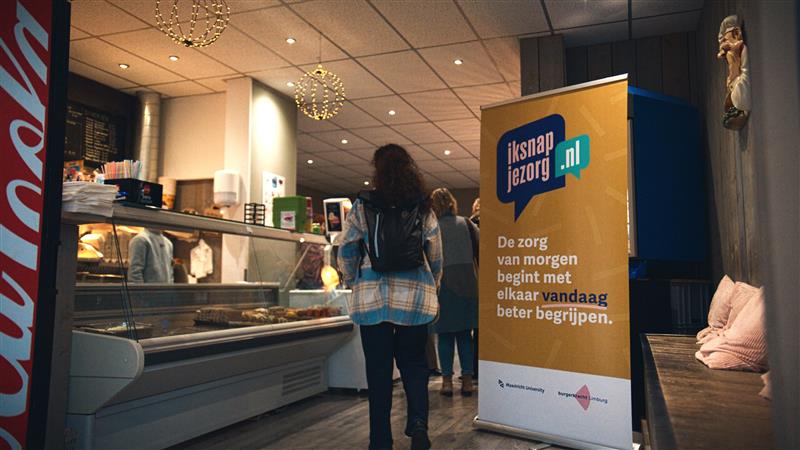
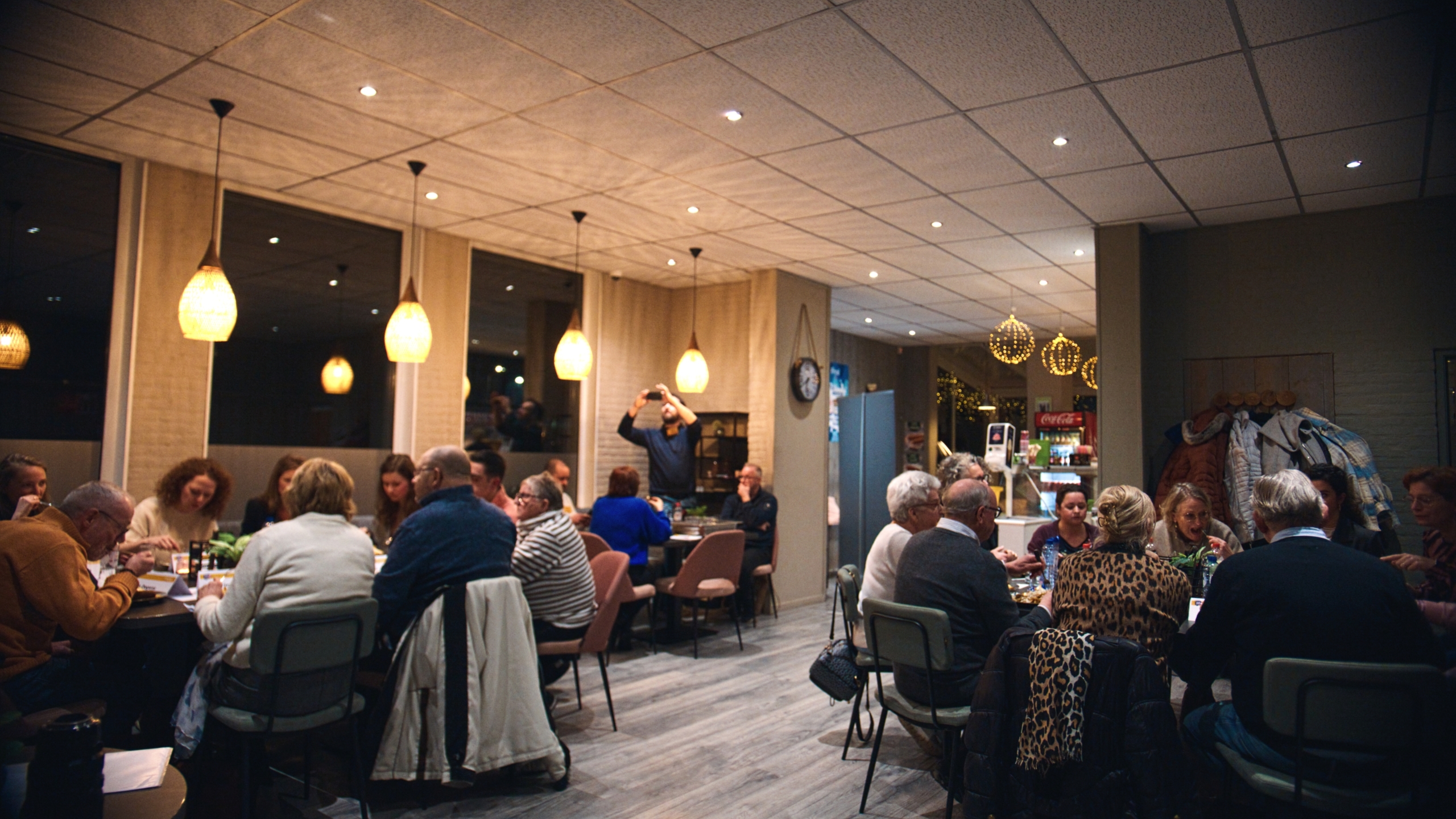
A striking example of taking a different approach is Frietpraat, part of the South Limburg project I Understand Your Care. Not the hospital, but the snack bar as a meeting place. Here, GPs, researchers, and residents discuss the future of primary care: informal, equal, and understandable.
I Understand Your Care shows how science, healthcare, and society can come closer together by literally going to the target group. In the snack bar, we reached people you wouldn’t see in the hospital. The snack bar owner even invited critical regulars. That’s where conversations happen that you would never have through a brochure or survey.
Research also shows that more people are interested in science than often assumed—provided it concerns them, is understandable, and they can contribute ideas on what should change. Not science for residents, but with them.
Conclusion: from advocacy to practice
As designers, communication professionals, and policymakers, we have a responsibility to structurally ensure inclusion. That requires more than just another app or platform, or simply saying that everyone is welcome. It starts with a different mindset: out of the bubble, into the community.
What does that mean in practice?
– Design with, not for, the target group. Involve people in thinking and decision-making from day one.
– Make accessibility a non-negotiable requirement: in language, visuals, channels, and usability.
– Trust comes before technology. Only those who feel heard will embrace digital healthcare.
Digitalization can make healthcare more efficient—but only if we design technology and communication together with the target group. Only then does digital healthcare reduce inequality instead of increasing it.
More?
Want to know more about how we make healthcare and communication inclusive in practice? Every day, we collaborate with partners such as the Citrien Program, the six Dutch university hospitals, Burgerkracht Limburg, Ambulance Services North-Middle-West Brabant, and Maastricht University to create inclusive, accessible healthcare.
Feel free to contact us; we’re happy to discuss your challenges and share our experiences.
Author: Sem Wigman, Creative Director Communications