25 June 2024
Strategy in Design
Strategy in design
As we see society, driven by new technologies, get more complex by the day, we seek new directions and ways to overcome the complexity. Predicting the future and how things will develop is difficult; how can we anticipate unknown factors that might affect our world in the (near) future? An answer lies in strategic thinking, designing and developing. Thinking ahead, combining creativity with a structured and research-driven approach to tackle (potential) issues is what strategy design is all about.
Designers who anticipate
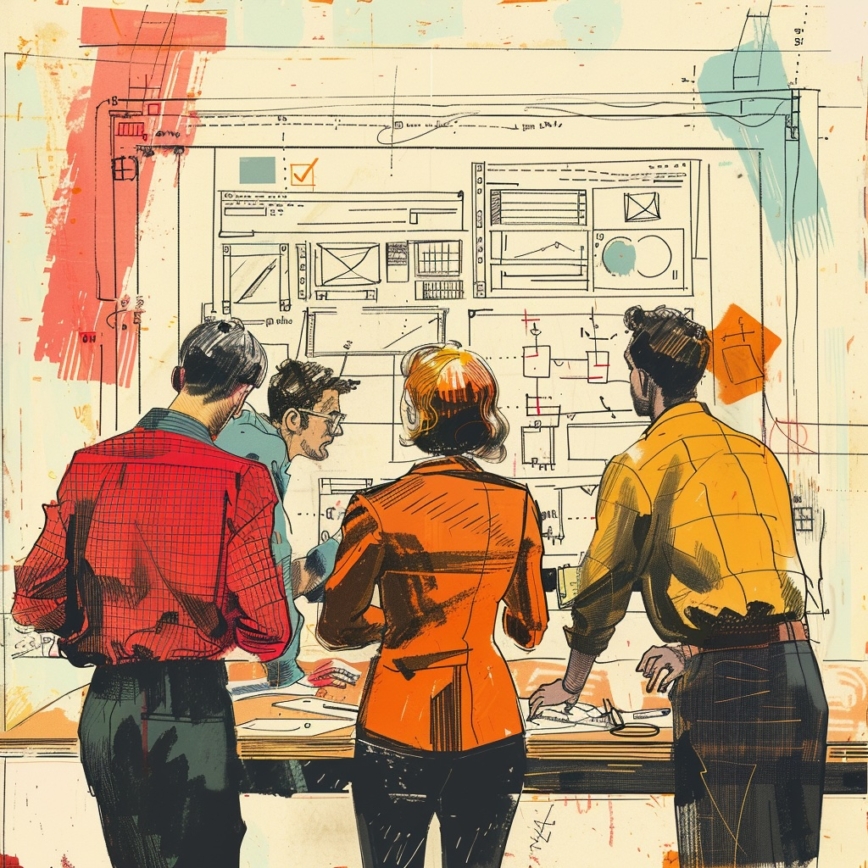
Strategy designers focus on the human aspects of businesses and organisations: on the reality for end-users, customers, employees, business partners and stakeholders. How do they think and operate, what do they experience and anticipate, what do they expect? And what do they dream of? And if we know the ‘now’, what about the future? Strategy designers take the lead in answering these questions by researching, structuring, imagining, ideating, conceptualising and creatively experimenting with possible solutions to meet (new) business needs and help the client succeed. Now and in the future. Why is this anticipatory approach more important than ever?
A world of overwhelming complexity
The world around is getting more complex by the day. Enabled by new technologies, we see society at large evolve into a more intricate entanglement of systems, rules, behaviours and expectations. From an increase in complexity, there appears potential for an increase in (unexpected) effects, both positively and negatively. New issues and challenges arise continuously in that sense, even as we seem to solve and overcome many of them. At Total Design we notice this too with our clients, who need to adapt their branding, communication and technology to be resilient to unexpected challenges. How can we deal with such challenges, in communication, in governance, in technology?
Design as the answer
While many of us regard ‘design’ as the beautifying of visible things, it is so much more. Design in the broadest sense is the (systemic) art of solving problems and overcoming challenges. To designers, challenges are found in everything, often ready to be tackled. When it comes to communication, a clear text or visual can help to overcome the challenge of misunderstanding. In governance, a new, improved way of working or information flow can be seen as the result of design efforts. Similarly, the largely invisible technology backing our modern information-rich economy and society is the result of research and trial-and-error driven design-engineering work. Thus, if we assume a broad sense of what design is, we see it everywhere. All man-made things, in the end, are designed. Not just the visible things, but also the invisible.
Elegance is essential
When things need to be structured in order to work, we are (subconsciously) attuned to elegance. Our clients know that Total Design has a heritage in seeking elegance and beauty to meet their needs. Not just on the surface though. A string of code that beautifully solves a complicated data issue, or an elegantly lean and logical governance model for internal and outward communication. Or think of a neatly structured gateway for securely linking and overseeing many virtual or physical connections. They all have a sense of beauty in common. Just as nature strives for beauty and elegance, so do good designers, engineers, managers and technicians. ‘If it looks good, it probably is good’ is an intuitive rule of thumb that describes how design principles can be found in any place where things are created. Even invisibly, design principles dictate technology. The best developers and engineers combine their deep (technical) expertise and experience with a very human sense of intuition. Creativity runs in the background while intuitively structuring and restructuring visible and technological components to find the best, most elegant solution to overcome the challenge at hand. At Total Design, we know that this is what design is.
The human side
Innovation is generally the result of creatively yet methodically structuring visible and invisible components (i.e. design), with the goals and context of a business or organisation in mind. The most important factor is the human at the center of it all. Design and technology according to human standards, meeting our expectations and in line with our ways of living and being. “Truly innovative” but complicated information systems might work in theory, but if people don’t get it or like it, they quickly revert to their old ways and ignore the “promised innovation”. Many innovations and transformations fail if they don’t ‘click’ with the humans. Keeping the people in mind, front and center stage, is what all designers naturally do, and this is essential for companies to succeed and progress. Good design is attuned to the inner workings of the client’s dream, their visions and hopes, their fears and insecurities. In other words, the deeply human side.
Strategy is the future
To meet a client’s wishes and design the best (innovative) thing requires tuning in with the human side. But we also have to consider an ever-changing and developing context. With a long heritage in design, Total Design also has to stay up-to-date with the changing world around us, to stay relevant, even in an uncertain future. Looking into the future requires a structured approach, a strategy. Innovation and design start with the client’s situation as it is. Where is a company situated, in terms of the market and context around them? What is the business ecosystem or governance model they’re part of? And what about all the different customers, users, employees and volunteers they (want to) deal with? Strategy designers, product-service designers and design thinkers go for the big picture of the current situation before diving into the (technical) details. Before the real creative work can even start, a lot of research is essential to prepare for the best outcomes.
Researching assumptions
When we do research at Total Design, we strive to find and identify assumptions about the current situation, the ‘as-is’. And after that, we look for the possible direction(s) ahead. Taking the assumptions and expectations into consideration, what are the options for proceeding that remain after we’ve crossed off the unfavourable variables? How can we proceed after (in)validating the assumptions based on the as-is situation? Once we get a full picture of the business or organisation and empathise with all the people involved, we can start envisioning the future and its practical technological aspects. Strategy designers can start planning and taking the first steps (however big or small) towards a new situation. Envisioning one or multiple future(s), on paper or digitally, in video or audio, in artifacts and snippets, is the basis for a guide for proceeding forwards. A map of the future. Dreaming big is the best, it leaves most options open and triggers optimism and creativity.
Dreams of design
Designers and innovators are dreamers; we like nothing more than impacting the world for positive change. And with a dream vision mapped out ahead, we can start the exciting journey of researching, creating, crafting, fumbling and experimenting our way past risks, opportunities, assumptions and hopes. We widen and narrow our focus and hope to arrive at the best solutions to the many challenges that come up. This is the power of strategy design: to dream and envision, to pragmatically approach challenges and to quickly zoom in and out, dreaming up ideas, finding practical solutions and rapidly testing and validating them. We map, evaluate and adjust the route(s) we want to take, and finally get to the most beautiful, elegant results on all fronts.
That is not just design. That is Total Design.
Author: Chris ten Dam, Strategy Designer TD