09 September 2025
The Blind Spot of Data-Driven Design
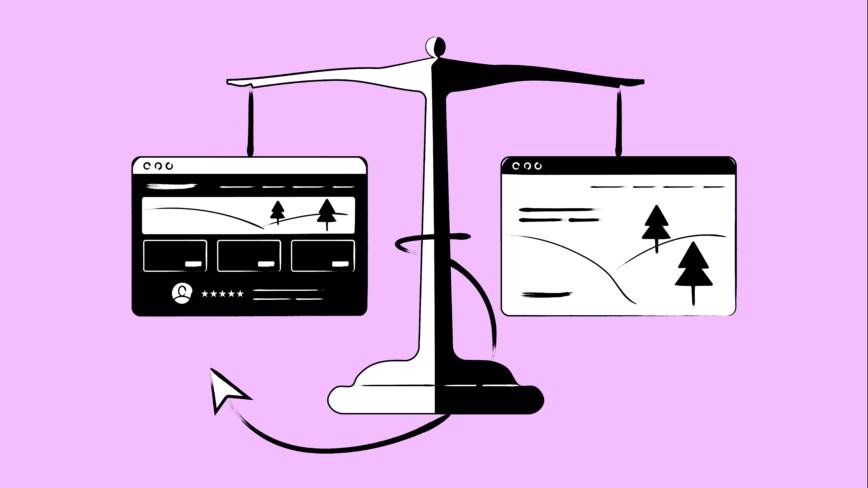
In a world where everything is measured – from click-through rates to micro-interactions – data seems to be the undisputed captain in design processes. Especially for websites and apps. But if success is based solely on numbers, you’re taking risks. Elements that are harder to quantify, such as emotion, surprise, and innovation, risk fading into the background. And at a time when AI increasingly offers standard solutions, it’s more important than ever to design off the beaten track.
We asked Robin Budy (Creative Director Tech and UX Designer), Jeroen Huynen (Online Marketing Consultant), and Ivo Straetmans (Senior Designer) of TD Zuiderlicht to reflect on this topic through a series of propositions.
Proposition 1: Online user data is the best foundation for design decisions
Robin: “Many of our tech projects revolve around KPIs and requirements. Everything has to be proven, measurable, and efficient. That’s understandable, but also restrictive. If you only steer within those boundaries, you rarely arrive at truly new ideas. I believe it’s those experiments and unexpected choices that make the biggest long-term difference for a brand or user—even if they can’t immediately be captured in numbers.”
Jeroen: “As a marketer, I’m expected to back up decisions with data, which makes sense. And with the huge amounts of data from social media, AI, and tracking, it seems like you can always draw solid conclusions. But that’s not the case. Data isn’t reality—it’s only a representation of what’s measurable. Or more precisely: what we once decided to measure. This often becomes a dangerous blind spot, for example when interpreting user behavior. Conclusions are drawn from data sets that are too small, or cherry-picked. Offline interactions and users with ad blockers are often left out. AI makes big data more accessible, but in truth, only big players like Google can really act on user behavior in real time.”
“You can’t reduce emotion to a dataset.”
Ivo: “If you rely only on data, you stay within a safe margin. And that margin is exactly where a brand fails to stand out. As a designer, I believe you should push boundaries whenever possible. Create a new standard instead of following the old one. Ultimately, I’m responsible for creating a consistent brand experience. Conveying emotion is an essential part of that—you can’t reduce it to a dataset.”
Robin: “When you deliberately do something that isn’t data-driven, it can be worth its weight in gold. A bold animation, a surprising interaction, a visual break from the norm—these may be harder to justify in numbers, but they often contribute the most to brand experience.”

Proposition 2: Data-driven design leads to sameness
Robin: “Data lets you fine-tune existing solutions, but it doesn’t create breakthroughs. To make a message stand out in the sea of digital stimuli, you need empathy and emotion. Otherwise, everything starts to look the same. As creatives, our job is to break conventions while maintaining high quality standards. That’s impossible if you only focus on what’s measurable and proven. For me, innovation often begins with daring to try something you’re not sure will work.”
“With data alone, you don’t create breakthroughs.”
Ivo: “I even see it happening in the tools we use. Software like InDesign pushes me toward safe, average choices. For instance, everything is automatically centered. It’s as if I’m being forced to work quickly and efficiently, making it harder to color outside the lines. Personally, I stay sharp in order to challenge the client. Not because I want to do extreme things for their own sake, but to explore what’s possible. I draw a lot of inspiration from the fashion world, where boundaries are constantly being pushed.”
Jeroen: “Good design starts with understanding your audience, getting to the heart of your story, and communicating it effectively. That requires emotion and intuition. Data can strengthen that, but never replace it. Clients sometimes lean too heavily on buzzwords like growth hacking or conversion optimization, without having a solid design as the foundation. If you endlessly optimize a mediocre concept, it will never truly stand out. You need creativity to break that cycle.”

Proposition 3: Emotion-driven design comes first, data-driven design follows
Robin: “The balance between emotion and data depends on context—such as the client, the goal, and the audience. You could say that the further along the customer journey you go, the more functional the design needs to be. Buttons, call-to-actions, and funnels become more important. But ideally, you use experimentation and measurement together: you try something new, and then use data to refine it.”
Jeroen: “Within that customer journey, the type of brand or product determines what leads the design. A functional webshop calls for data-driven choices, while a luxury brand’s site leans heavily on emotional value. On the latter, making the ‘contact us’ button bigger may slightly increase clicks, but the question is whether those leads are truly valuable.”
Ivo: “In the end, you need both emotion-driven and data-driven design. Which one takes the lead depends on the medium. Because without measured data, and without conventional blocks and buttons, emotion has no value either. You need a working structure. It’s the interplay of the two that creates the most exciting possibilities for the future.”
Two captains on one ship
Data helps us provide structure, optimize, and justify decisions—especially when marketing budgets shrink. But those who steer solely by numbers risk sailing a flat, safe course. This creates blind spots and kills innovation.
As a creative agency, we don’t believe in one captain on the ship, but two: data-driven and emotion-driven design. Data is never a complete reflection of reality. Safety doesn’t lead to renewal. And without an emotional foundation, you can’t create a brand experience that truly resonates.
For us, intuitive, emotion-driven design remains the core—even in these data-first times. Data adds a valuable layer that helps refine that core. Together, they create brands that don’t just perform, but endure.
Authors: Eliza Marx and Krista Lahaye, TD Zuiderlicht