15 April 2025
What if your competitor uses AI smarter than you?
AI is not only changing how companies operate but also determining who wins and who gets left behind. It has long shifted from being just about automating repetitive tasks. AI is changing strategy, innovation and even how companies compete. So the question is not whether AI will impact your industry, but how quickly you adapt. And that’s where strategic AI adoption comes in.
AI changes everything
We are on the eve of a fundamental transformation. In the coming years, AI will have a profound impact on how organizations function. Not only will routine or administrative tasks be automated, but strategic and creative processes will also change dramatically. This affects the way companies differentiate themselves, how teams work together and how innovation is achieved.
AI is an evolutionary leap more significant than the introduction of the Internet. This requires a different way of thinking. Organizations that want to successfully adapt to this new reality must see AI not merely as a tool to become more efficient, but as a catalyst for fundamental change. Technology and organizational development must go hand in hand, in a strategic reorientation that affects the entire organization.
The four phases of AI transformation
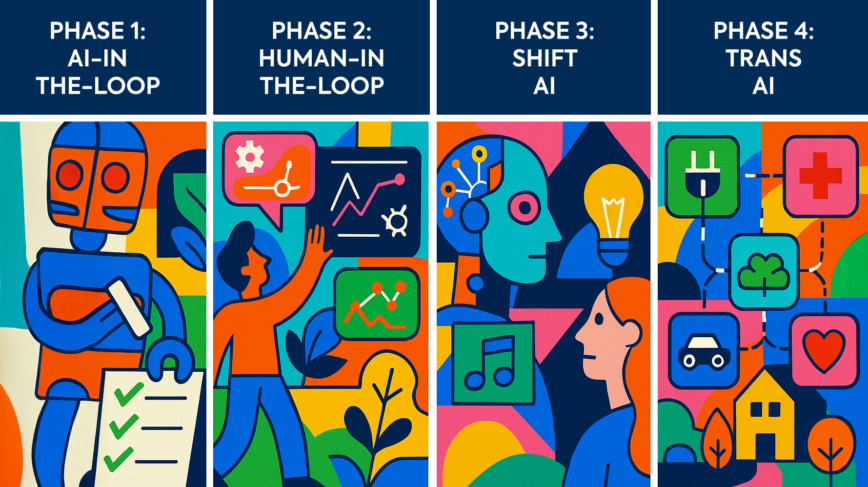
Phase 1: AI-in-the-loop – efficiency within existing processes
In this first phase, AI is added to existing workflows without actually changing the underlying processes. The technology acts primarily as an advanced tool – a “smarter hammer” – that helps perform tasks faster, more consistently or better. Think of banks using AI for automated fraud detection or retail companies optimizing their inventory management with predictive algorithms.
Productivity gains are often limited at this stage, about 10 to 20 percent, but not insignificant. It serves as a learning curve for organizations: employees become familiar with AI and awareness of its potential applications develops. Thus, this phase is the necessary prelude to deeper integration and transformation.
Phase 2: Human-in-the-loop – process change and optimization
In the second phase, AI is no longer just applied within existing structures, but is forcing organizations to fundamentally rethink the way they work. Decision-making processes are being redesigned with AI as an integral part, and workflows are being modified to take full advantage of machine learning and automation. For example, consulting firms are using AI analytics to arrive at client recommendations faster, while manufacturing companies are restructuring supply chains using predictive models.
The human role is changing substantially in this phase. Whereas before it was mainly executive, the focus is shifting to directing AI-driven processes. This places different demands on skills, direction, and management styles. It is also the phase in which organizations not only become more efficient but also boost their capacity for innovation.
Phase 3: Shift-AI – radical transformation and innovation
The third phase represents a true paradigm shift. Here it is no longer about optimization, but about fundamental innovation. AI is deployed to create entirely new products, services, and even business models. Organizations that take this step are not building on what is already there, but developing something completely new. Think of how Netflix developed an entirely new business model around AI-driven recommendations.
This phase is the domain of strategic renewal, of long-term competitive advantage. It requires a progressive culture, new organizational structures, and a radically different way of thinking. Companies that come here do not just reinvent themselves – they (re)shape their entire industry.
Phase 4: Trans-AI – from silos to ecosystems
In the fourth phase of AI transformation, we make the leap from individual organizations to a more intertwined business, intertwined with its suppliers, customers and employees or its environment, but also intertwined with AI agents. The boundaries of the individual organization are blurring and there will be more interaction with the environment, both physical and virtual.
Whereas in earlier phases you had your own grip on your “own” AI systems, here we see the emergence of distributed intelligence: multiple AI agents, each representing its own task, role, or perspective within a larger ecosystem. These agents communicate with each other, coordinate among themselves, negotiate where necessary, and respond independently to changing circumstances. This creates a dynamic interplay in which the collective intelligence is greater than the sum of its parts. And also reasons more broadly than just its own organizational context and goals.
The human supervises, but no longer directs each individual process. Instead, humans monitor the frameworks within which these agents operate and intervene only when necessary. This marks a fundamental shift in how organizations function, make decisions, and organize around technology.
So what, specifically, does this mean? Consider smart neighborhood development. Imagine an AI ecosystem in which city planning AI, energy grid AI, traffic AI, and healthcare AI are connected. When a new residential development is planned somewhere, these agents together calculate in real time how much healthcare capacity is needed, whether the local energy grid can handle the demand, what the impact is on air quality and traffic congestion, and whether supermarkets and gyms and the like need to adjust their offerings based on demographic data. Everything is negotiated with companies, institutions, and citizens or consumers. What used to be separate policy domains, companies and individuals now become one intelligent and self-learning system. This allows for faster and more accurate decisions with the bigger picture in mind.
Another example is AI for climate adaptation. AI agents from water boards, agricultural organizations, energy companies, and insurers share data on precipitation, soil conditions, and climate predictions. Together, they anticipate drought or flooding, adjust irrigation systems, adjust subsidies, and warn citizens via their personal weather and risk profiles. Connecting these sectors creates a system that is not only adaptive but also acts preventively – with enormous value in terms of sustainability, safety, and economic resilience.
Strategically, this phase opens doors to extreme adaptivity and new forms of organization. Organizations can calculate scenarios, adjust strategy in real time, and deliver personalized services at unprecedented scales. They are evolving from linear operations to living networks. Organizations that get here are transforming from independent entities to nodes in a larger web of shared intelligence. This also has major implications for brand and communication. In a world where not just humans but AI agents make choices, radical transparency becomes a prerequisite for trust and collaboration.
Brands must make clear what their AI does, what values underlie it, and how it makes decisions. Because in an ecosystem of autonomous agents, it’s not just what you do that counts – but how you function in relation to others. The organizations that understand this and set themselves up accordingly will be the system players of tomorrow.
From strategy to action? Start small, think big
For organizations looking to adopt AI strategically, it is crucial to take a structured and phased approach to the transformation. Start with small, measurable successes in phase one. Integrate AI into existing processes and improve efficiency while employees become familiar with the technology. From there, you can move on to redesigning processes in phase two. A good approach here is to work with feedback loops. Regular evaluation and adjustment based on input from both AI and people ensure continuous improvement as well as increased support.
In phase three, it is time for real innovation. Organizations must then dare to experiment with new ideas, business models, and value propositions. This can be done in an innovation lab or sandbox environment, where teams can experiment freely without disrupting daily operations. This creates space to learn from failures and scale up successful innovations.
And those who want to think even further ahead are already preparing for phase four. Not by immediately building large-scale multi-agent system solutions, but by developing strategic scenarios, exploring ecosystems, and forging partnerships in which shared intelligence is central.
The human factor in AI transformation
In the end, successful AI integration is about more than just technology. The human factor remains essential. Success depends not only on the implementation of tools but especially on the people who work with them – and the vision that gives them direction.
Organizations that will now invest in skills, mindset, and a clear vision of the role of AI will not only operate more efficiently. They will also differentiate themselves, adapt faster and, in doing so, actively (help) shape the future of their industry.
AI offers unprecedented opportunities for transformation and innovation. By starting small and thinking big, organizations can incrementally integrate AI and structurally strengthen their competitive position. In doing so, it is essential to see AI as a catalyst for change – not just a tool for efficiency. Companies that make this vision their core are the system players and market leaders of tomorrow.
Authors: Martijn Arts and Sieds de Boer
Wondering how AI can fundamentally strengthen your organization? We help C-level executives and their teams identify opportunities and design an AI strategy that matches their ambitions. Feel free to request an exploratory conversation with one of our experts: AI@totaldesign.com